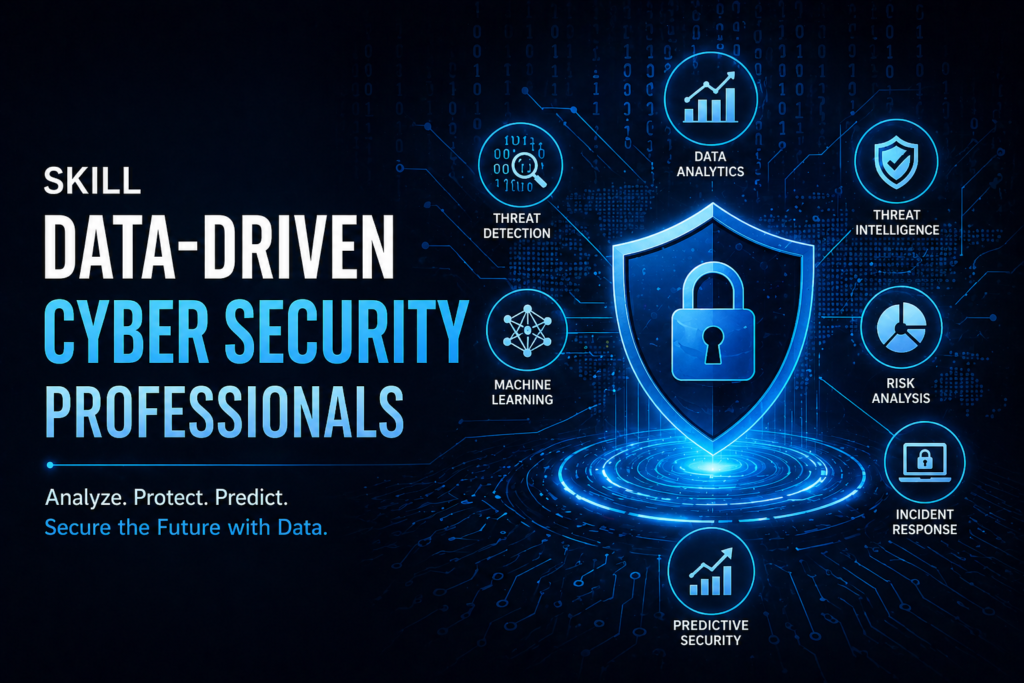
Top Skills for Data-Driven Cyber Security Professionals
Introduction
Cybersecurity is no longer limited to firewalls, antivirus tools, and basic network protection. As organizations generate massive volumes of digital data, cyber threats have also become more intelligent and sophisticated. This is where data-driven cybersecurity is changing the game.
Modern cybersecurity professionals are now expected to combine traditional security knowledge with data analysis, machine learning, automation, and predictive intelligence. Companies want professionals who can not only detect threats but also analyze data patterns, predict attacks, and make faster security decisions.
In 2026, the demand for data-driven cybersecurity professionals is increasing rapidly across industries such as banking, healthcare, e-commerce, government, and IT services.
In this blog, we will explore the top skills required to become a successful data-driven cybersecurity professional.
What is Data-Driven Cyber Security?
Data-driven cybersecurity means using data analysis, machine learning, and intelligent systems to strengthen security operations.
Instead of relying only on manual monitoring, organizations use data to:
- Detect suspicious behavior
- Identify anomalies
- Predict attacks
- Improve incident response
This approach makes cybersecurity more proactive and scalable.
Why Data-Driven Skills Matter in Cyber Security
Modern organizations collect huge amounts of security data, including:
- Network logs
- User behavior data
- Access logs
- Threat intelligence feeds
- Application activity
Without analytical skills, this data is difficult to interpret.
Data-driven professionals help organizations convert raw data into actionable security insights.
Benefits include:
- Faster threat detection
- Better risk management
- Reduced false positives
- Smarter automation
Top Skills for Data-Driven Cyber Security Professionals
1. Cyber Security Fundamentals
Before combining data with security, you must understand cybersecurity basics.
Core concepts include:
- Network security
- Access control
- Encryption
- Authentication
- Firewalls
- Vulnerability management
Without strong fundamentals, advanced analytics will not be effective.
2. Networking Knowledge
Cybersecurity professionals must understand how networks function.
Important topics:
- TCP/IP
- DNS
- HTTP/HTTPS
- VPNs
- Routing and switching
Networking knowledge helps identify abnormal traffic and suspicious communication patterns.
3. Data Analysis Skills
This is one of the most important skills.
Professionals should know how to:
- Clean data
- Analyze trends
- Identify anomalies
- Interpret security logs
Data analysis enables better security decision-making.
Examples:
- Failed login analysis
- Network anomaly detection
- Fraud behavior patterns
4. Python Programming
Python is widely used in both cybersecurity and data science.
It helps with:
- Automation
- Script development
- Data analysis
- Threat intelligence
Common Python libraries:
- Pandas
- NumPy
- Scikit-learn
Python is essential for modern security professionals.
5. SQL & Database Knowledge
Security teams often work with structured data.
SQL helps query:
- Security logs
- User activity
- Transaction data
Examples:
- Suspicious transactions
- Failed authentication attempts
SQL is valuable for log investigation and security analytics.
6. Machine Learning Basics
Machine learning is increasingly used in cybersecurity.
Applications include:
- Threat detection
- Fraud detection
- Malware classification
- Behavioral analytics
Professionals should understand:
- Classification models
- Anomaly detection
- Clustering
Even basic ML knowledge adds strong value.
7. SIEM Tools
Security Information and Event Management (SIEM) tools are critical.
Popular SIEM tools:
- Splunk
- IBM QRadar
- ArcSight
- Microsoft Sentinel
These tools collect and analyze security data.
Skills include:
- Log correlation
- Alert monitoring
- Dashboard analysis
8. Threat Intelligence
Cyber professionals should understand threat landscapes.
Important areas:
- Threat actors
- Attack techniques
- Indicators of compromise (IOCs)
Threat intelligence helps organizations stay prepared.
Frameworks:
- MITRE ATT&CK
- STIX/TAXII
9. Incident Response Skills
Security incidents require fast action.
Professionals should know:
- Detection
- Investigation
- Containment
- Recovery
Incident response is a high-value skill.
Strong analytical ability improves response quality.
10. Cloud Security
Organizations are moving to cloud platforms.
Cloud security knowledge is highly important.
Learn:
- AWS security
- Azure security
- Google Cloud security
Key concepts:
- IAM
- Cloud monitoring
- Data protection
Cloud security demand is growing rapidly.
11. Automation & Scripting
Manual security operations are slow.
Automation helps:
- Threat detection
- Alert response
- Log management
Useful tools:
- Python scripts
- SOAR platforms
Automation improves operational efficiency.
12. Data Visualization
Security data must often be presented clearly.
Visualization tools help communicate insights.
Popular tools:
- Power BI
- Tableau
- Kibana
Examples:
- Security dashboards
- Threat trends
- Incident reports
Visualization improves executive reporting.
13. Problem-Solving & Analytical Thinking
Cybersecurity is fundamentally about solving problems.
Professionals must:
- Investigate patterns
- Connect signals
- Identify root causes
Analytical thinking is essential in threat hunting and investigations.
14. Risk Assessment
Not all threats are equal.
Professionals should evaluate:
- Probability
- Business impact
- Severity
Risk analysis helps prioritize security efforts.
15. Communication Skills
Technical skills alone are not enough.
Cybersecurity professionals must explain:
- Threats
- Risks
- Recommendations
to non-technical stakeholders.
Strong communication increases career growth opportunities.
Career Opportunities
With these skills, you can pursue roles such as:
- SOC Analyst
- Cyber Security Analyst
- Threat Intelligence Analyst
- Security Data Analyst
- Fraud Analyst
- Cloud Security Specialist
These roles are highly in demand globally.
Future Scope
The future of cybersecurity is increasingly data-driven.
Emerging trends:
- AI-powered SOC
- Autonomous threat detection
- Behavioral analytics
- Predictive security
Professionals who combine security + data skills will have a major competitive advantage.
Conclusion
Cybersecurity is evolving from traditional defense to intelligent, data-driven protection.
Modern professionals need more than basic security knowledge.
They must combine:
- Security fundamentals
- Data analytics
- Automation
- Machine learning
Organizations are actively seeking professionals who can protect systems using data-backed insights.