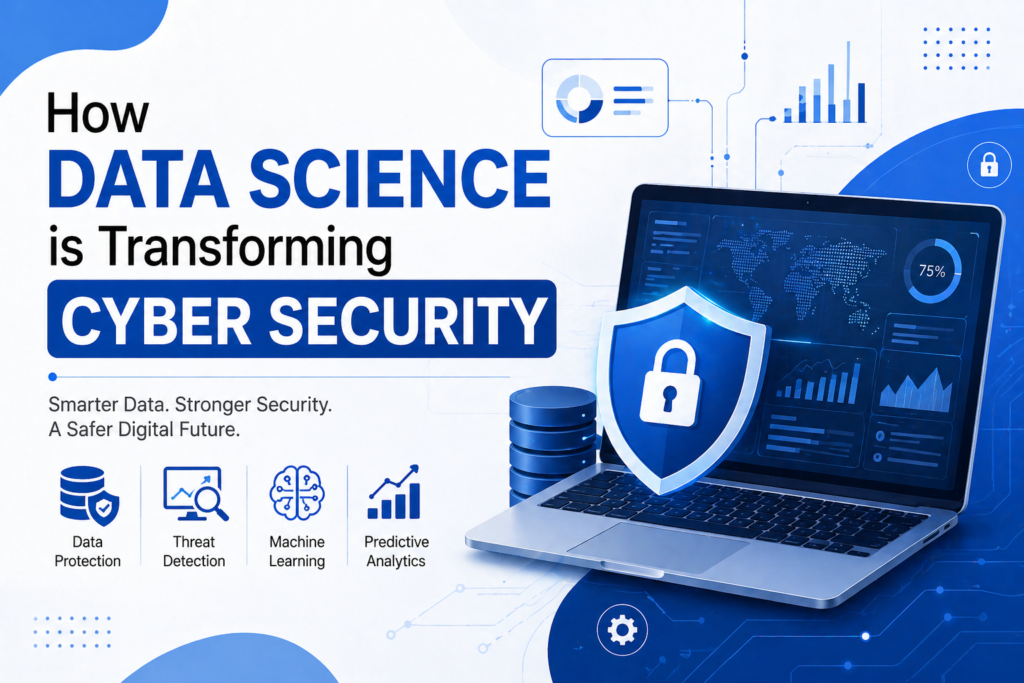
How Data Science is Transforming Cyber Security
Introduction
As cyber threats continue to evolve, traditional security systems are no longer enough to protect businesses and individuals from sophisticated attacks. Organizations today face phishing attacks, ransomware, malware, insider threats, and data breaches on a daily basis.
This is where Data Science is playing a major role in transforming cybersecurity. By using data analysis, machine learning, predictive models, and automation, cybersecurity is becoming smarter, faster, and more proactive.
Data Science helps organizations detect threats early, analyze huge volumes of security data, and improve incident response. In simple terms, it is helping cybersecurity shift from a reactive approach to a predictive one.
In this blog, we will explore how Data Science is revolutionizing cybersecurity and why this combination is becoming one of the most in-demand skills in 2026.
What is Data Science?
Data Science is the process of collecting, cleaning, analyzing, and interpreting data to extract valuable insights.
It uses multiple disciplines such as:
- Statistics
- Machine Learning
- Artificial Intelligence
- Data Visualization
- Programming
The goal is to identify patterns, make predictions, and support decision-making.
When applied to cybersecurity, Data Science enables systems to identify suspicious activities and respond to threats faster.
Why Cyber Security Needs Data Science
Modern cybersecurity generates enormous amounts of data.
Examples include:
- Login attempts
- Network traffic
- User behavior
- File access logs
- Device activity
- Threat intelligence feeds
Manually analyzing such large data volumes is nearly impossible.
Data Science solves this problem by automating analysis and identifying anomalies in real time.
Benefits include:
- Faster threat detection
- Better risk assessment
- Reduced false positives
- Improved automation
Key Ways Data Science is Transforming Cyber Security
1. Threat Detection and Anomaly Detection
One of the biggest applications of Data Science in cybersecurity is anomaly detection.
Machine learning models analyze normal user and system behavior. When unusual activity occurs, the system flags it immediately.
Examples:
- Suspicious login from unknown location
- Sudden spike in data downloads
- Unusual network traffic
This helps organizations detect attacks before major damage occurs.
2. Fraud Detection
Financial fraud is a major challenge for banks, fintech companies, and e-commerce platforms.
Data Science helps detect fraud by analyzing transaction patterns.
For example:
If a user normally spends ₹5,000 daily but suddenly makes multiple transactions worth ₹2 lakh from another country, the system can flag or block the transaction.
Applications:
- Credit card fraud detection
- Banking fraud
- Payment fraud
3. Malware Detection
Traditional antivirus systems rely heavily on signature-based detection.
This approach fails against new or modified malware.
Data Science improves malware detection through behavioral analysis.
Instead of checking signatures, AI models study how files behave.
Example:
- File modifies system settings
- Unauthorized registry changes
- Suspicious process execution
This helps detect zero-day threats more effectively.
4. Predictive Security Analytics
Data Science enables predictive analysis.
Instead of only responding to attacks, organizations can predict risks.
Machine learning models analyze:
- Historical attack patterns
- Vulnerability trends
- User behavior
This helps organizations identify:
- Which systems are most vulnerable
- Where future attacks may happen
Predictive security is a major advancement in cybersecurity strategy.
5. Security Automation
Cybersecurity teams often handle repetitive tasks.
Examples:
- Log analysis
- Alert prioritization
- Threat classification
Data Science automates these workflows.
Benefits:
- Faster incident response
- Lower operational cost
- Better analyst productivity
Security teams can focus on strategic tasks instead of manual monitoring.
6. Insider Threat Detection
Not all cyber threats come from outside.
Employees or internal users can pose risks.
Examples:
- Data theft
- Unauthorized access
- Credential misuse
Data Science monitors user behavior patterns.
It can identify:
- Unusual file downloads
- Off-hours activity
- Access anomalies
This helps organizations reduce insider risks.
7. Vulnerability Management
Organizations manage thousands of vulnerabilities.
Not all vulnerabilities are equally dangerous.
Data Science helps prioritize vulnerabilities based on:
- Risk score
- Exploit likelihood
- Business impact
This improves patch management efficiency.
Instead of patching randomly, teams focus on critical risks first.
Real-World Applications
Data Science + Cyber Security is already used in:
Banking
- Fraud detection
- Risk scoring
Healthcare
- Patient data protection
- Access monitoring
E-commerce
- Payment fraud prevention
- Account takeover detection
Government
- Threat intelligence
- National security systems
Enterprises
- SOC automation
- Threat hunting
Career Opportunities in Data Science + Cyber Security
The combination of Data Science and Cyber Security is creating exciting career opportunities.
Popular job roles:
- Cyber Security Data Analyst
- Threat Intelligence Analyst
- Security Data Scientist
- Fraud Analyst
- SOC Analyst with ML expertise
- AI Security Specialist
These roles are highly in demand globally.
Skills Required
To build a career in this field, learn:
- Python
- SQL
- Machine Learning
- Cyber Security fundamentals
- Network Security
- Data Visualization
- Threat Analysis
Knowledge of tools like:
- Splunk
- Power BI
- Tableau
- Wireshark
- SIEM tools
can also be useful.
Future Scope
As cyber attacks become more advanced, the need for intelligent security systems will increase.
Future trends include:
- AI-driven SOC operations
- Autonomous threat detection
- Behavioral analytics
- Predictive risk modeling
Organizations are investing heavily in AI-powered cybersecurity.
This makes Data Science + Cyber Security one of the strongest future-proof career combinations.
Conclusion
Data Science is fundamentally transforming cybersecurity by making it more intelligent, automated, and predictive.
Instead of simply reacting to threats, organizations can now:
- Predict attacks
- Detect anomalies
- Automate workflows
- Reduce risks faster
As digital transformation grows, the intersection of Data Science and Cyber Security will continue to create massive career and business opportunities.
Professionals who combine both skills will be highly valuable in the coming years.