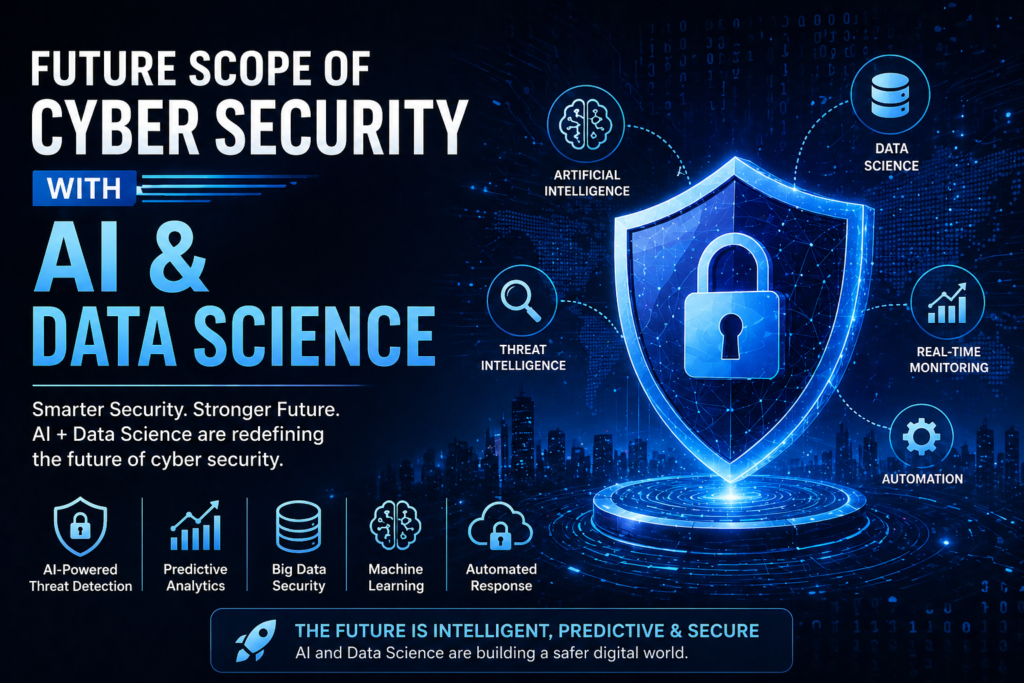
Future Scope of Cyber Security with AI & Data Science
Introduction
The digital world is expanding rapidly. Businesses, governments, healthcare systems, financial institutions, and even individuals are becoming increasingly dependent on technology. With this digital growth comes a major challenge: cyber threats.
Cyberattacks are becoming more advanced, frequent, and expensive. Traditional cybersecurity methods are no longer sufficient to handle modern threats like ransomware, phishing, insider attacks, malware, and data breaches.
This is where Artificial Intelligence (AI) and Data Science are revolutionizing cybersecurity.
AI and Data Science are making cybersecurity smarter, faster, and more predictive. Instead of simply reacting to attacks, organizations can now identify patterns, predict risks, and automate threat detection.
In 2026 and beyond, the future of cybersecurity will be heavily driven by AI and data-powered systems.
Why Traditional Cyber Security is No Longer Enough
Traditional cybersecurity relies on:
- Rule-based systems
- Signature detection
- Manual monitoring
- Reactive incident handling
While these methods still matter, they have limitations.
Challenges include:
- Massive security data volumes
- Zero-day attacks
- Sophisticated phishing campaigns
- Advanced persistent threats (APTs)
Human teams cannot manually analyze millions of security events daily.
This creates a need for intelligent systems.
Role of AI in Cyber Security
Artificial Intelligence enables machines to analyze data, detect anomalies, and make decisions faster.
In cybersecurity, AI helps with:
- Threat detection
- Malware analysis
- Fraud detection
- Risk scoring
- Security automation
AI systems can learn from previous attacks and improve continuously.
Example Use Cases of AI in Cyber Security
1. Threat Detection
AI analyzes:
- Network traffic
- Login attempts
- User behavior
It can detect suspicious patterns instantly.
Example:
- Unusual login from unknown country
- Sudden file downloads
- Suspicious IP activity
This reduces detection time significantly.
2. Malware Detection
Traditional antivirus uses signatures.
AI improves this by analyzing malware behavior.
AI can identify:
- Suspicious file execution
- System modifications
- Abnormal processes
This helps detect unknown threats.
3. Fraud Detection
Banks and fintech companies use AI to detect fraud.
AI monitors:
- Transactions
- Spending patterns
- Login behavior
Example:
If a user normally shops in India but suddenly makes multiple international purchases, AI can flag it.
4. Security Automation
AI automates repetitive tasks:
- Alert prioritization
- Threat correlation
- Incident response
Benefits:
- Faster operations
- Reduced workload
- Better efficiency
Role of Data Science in Cyber Security
Data Science focuses on extracting insights from large datasets.
Cybersecurity generates massive data, including:
- Logs
- User activity
- Network events
- Threat intelligence
Data Science helps analyze and interpret this information.
Applications include:
- Anomaly detection
- Predictive security
- Behavioral analytics
How Data Science Enhances Security
1. Predictive Analytics
Data Science identifies future risks using historical patterns.
Organizations can predict:
- Attack likelihood
- Vulnerable systems
- Threat trends
This improves preparedness.
2. Behavioral Analytics
Data Science monitors user behavior.
It detects:
- Unusual access patterns
- Insider threats
- Credential abuse
Example:
An employee suddenly downloading large confidential files.
3. Security Dashboards & Visualization
Security teams need actionable insights.
Data Science tools create dashboards showing:
- Threat trends
- Incident patterns
- Risk metrics
Popular tools:
- Power BI
- Tableau
- Kibana
Future Trends in Cyber Security with AI & Data Science
1. Autonomous Security Systems
Future systems will automatically:
- Detect threats
- Investigate incidents
- Block attacks
Minimal human intervention will be required.
2. AI-Powered Security Operations Centers (SOC)
Modern SOCs are becoming AI-driven.
AI can:
- Analyze alerts
- Reduce false positives
- Prioritize incidents
This improves analyst productivity.
3. Predictive Threat Intelligence
Instead of waiting for attacks, organizations will predict them.
AI + Data Science will analyze:
- Threat actor behavior
- Vulnerabilities
- Global attack trends
This creates proactive defense systems.
4. Zero Trust Security
Zero Trust assumes no user is automatically trusted.
AI strengthens Zero Trust by continuously monitoring:
- Device behavior
- User activity
- Access requests
This reduces unauthorized access.
5. Cloud Security Intelligence
As organizations move to cloud platforms, AI-based cloud security will grow.
Use cases:
- Cloud anomaly detection
- IAM monitoring
- Cloud threat analytics
Demand for cloud security professionals will rise.
Career Opportunities in This Domain
The combination of Cyber Security + AI + Data Science is creating high-growth careers.
Popular roles:
- AI Security Analyst
- Cyber Security Data Analyst
- Threat Intelligence Analyst
- Security Data Scientist
- SOC Analyst
- Fraud Analyst
These roles offer strong salaries globally.
Skills Required for Future Professionals
To build a career in this field, learn:
- Python
- SQL
- Machine Learning
- Cyber Security fundamentals
- Networking
- Cloud security
Tools:
- Splunk
- Power BI
- Tableau
- SIEM tools
These skills are becoming highly valuable.
Salary Potential
Professionals in AI-powered cybersecurity roles often earn premium salaries.
India:
- Entry level: ₹5–10 LPA
- Mid-level: ₹12–25 LPA
- Experienced: ₹30L+
Global:
- $90,000 – $200,000+
The salary growth is strong due to skill scarcity.
Why This Career Has Strong Future Scope
Reasons include:
- Increasing cyber threats
- AI adoption growth
- Data explosion
- Cloud migration
- Regulatory compliance
Organizations cannot afford weak cybersecurity.
Demand will continue growing for years.
Conclusion
The future of cybersecurity is no longer just about protection—it is about intelligent defense.
AI and Data Science are transforming cybersecurity by enabling:
- Faster threat detection
- Better automation
- Predictive analytics
- Smarter incident response
As cyber threats evolve, organizations will increasingly depend on professionals who understand both security and data.