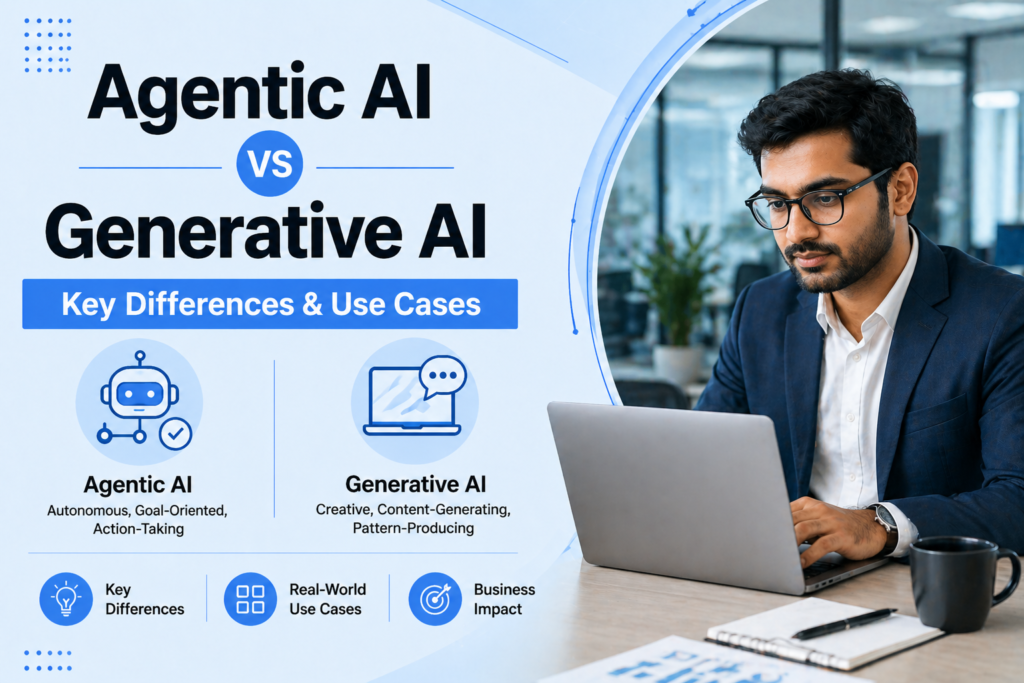
Agentic AI vs Generative AI: Key Differences & Use Cases
Introduction
Artificial Intelligence is evolving rapidly, and two terms that are gaining massive attention in 2026 are Generative AI and Agentic AI. While both are built on advanced AI systems, their purpose, functionality, and real-world applications are very different.
Many professionals, students, and businesses are still confused about the difference between these technologies. Is Agentic AI simply the next version of Generative AI? Can one replace the other? Which technology has better career opportunities?
In this blog, we will break down the key differences between Agentic AI and Generative AI, along with their practical use cases.
What is Generative AI?
Generative AI refers to AI systems designed to create new content based on the data they have been trained on.
These systems can generate:
- Text
- Images
- Videos
- Code
- Audio
- Designs
Popular examples of Generative AI tools include ChatGPT, Midjourney, DALL·E, GitHub Copilot, and Gemini.
For example, when you ask an AI chatbot to write a blog, generate an image, or summarize a report, you are using Generative AI.
Core Function of Generative AI
Its primary purpose is content generation and creativity assistance.
It takes user input (prompt) and generates relevant output.
Example:
Prompt → “Write a social media caption for a fashion brand”
Output → AI-generated caption
What is Agentic AI?
Agentic AI is more advanced and action-oriented.
Instead of just generating content, Agentic AI can:
- Make decisions
- Plan tasks
- Take actions
- Execute workflows autonomously
It behaves more like an intelligent agent working toward a goal.
For example, instead of only suggesting travel plans, an Agentic AI system could:
- Compare flights
- Book tickets
- Schedule hotel stays
- Add calendar reminders
—all with minimal human intervention.
Core Function of Agentic AI
Its primary purpose is autonomous execution and decision-making.
It can analyze a task, break it into steps, and complete the process.
Key Differences Between Agentic AI and Generative AI
1. Purpose
Generative AI
Focuses on creating content.
Examples:
- Writing blogs
- Generating code
- Designing images
Agentic AI
Focuses on completing goals or actions.
Examples:
- Automating workflows
- Task execution
- Business operations
2. Human Dependency
Generative AI
Requires continuous prompting.
It works based on user instructions.
Example:
“Create a logo”
It waits for commands.
Agentic AI
Requires less human intervention.
It can independently perform tasks after receiving a goal.
Example:
“Plan and execute a marketing campaign”
3. Decision-Making Ability
Generative AI
Limited decision-making.
It predicts outputs but does not truly decide or act.
Agentic AI
Can prioritize, decide, and optimize actions.
It can evaluate options and choose the best path.
4. Workflow Automation
Generative AI
Supports work creation.
It assists.
Agentic AI
Can automate entire workflows.
It executes.
5. Complexity Level
Generative AI
Relatively simpler to use.
Prompt → Output.
Agentic AI
More complex.
Goal → Planning → Execution → Monitoring.
Real-World Use Cases of Generative AI
Generative AI is already widely used across industries.
Content Marketing
- Blog writing
- Social media posts
- Email marketing
Graphic Design
- Posters
- Banners
- Logo concepts
Software Development
- Code generation
- Debugging support
Education
- Notes generation
- Quiz creation
- Personalized explanations
Customer Support
- Chatbots
- FAQ automation
Real-World Use Cases of Agentic AI
Agentic AI is becoming popular in automation-heavy industries.
Business Automation
- CRM workflows
- Lead management
- Reporting automation
Finance
- Portfolio monitoring
- Risk alerts
- Transaction automation
HR & Recruitment
- Resume screening
- Interview scheduling
- Candidate communication
Operations
- Supply chain optimization
- Task scheduling
Personal Productivity
- Smart assistants that manage workflows
Which One Has Better Career Scope?
Both technologies have strong career opportunities.
Careers in Generative AI
- Prompt Engineer
- AI Content Specialist
- AI Designer
- AI Product Specialist
Careers in Agentic AI
- AI Automation Engineer
- AI Workflow Architect
- AI Operations Specialist
- Autonomous Systems Developer
Which Technology Should You Learn in 2026?
The ideal approach is not choosing one over the other.
Instead:
Learn Generative AI if you want:
- Content creation
- Marketing
- Design
- Productivity enhancement
Learn Agentic AI if you want:
- Automation
- AI workflows
- Business process optimization
- Advanced AI systems
The future belongs to professionals who can combine both.
Example:
Use Generative AI to create content.
Use Agentic AI to automate distribution and execution.
That combination is extremely powerful.
Future Outlook
Generative AI changed how humans create.
Agentic AI is changing how systems think, plan, and act.
In the next few years:
- Generative AI will become a productivity standard
- Agentic AI will become a business automation revolution
Businesses will increasingly adopt AI agents for decision-making and workflow execution.
This means professionals who understand both technologies will have a major competitive advantage.
Conclusion
Generative AI and Agentic AI are not competitors—they solve different problems.
Generative AI helps create.
Agentic AI helps execute.
If Generative AI is the “brainstorming partner,” Agentic AI is the “task executor.”