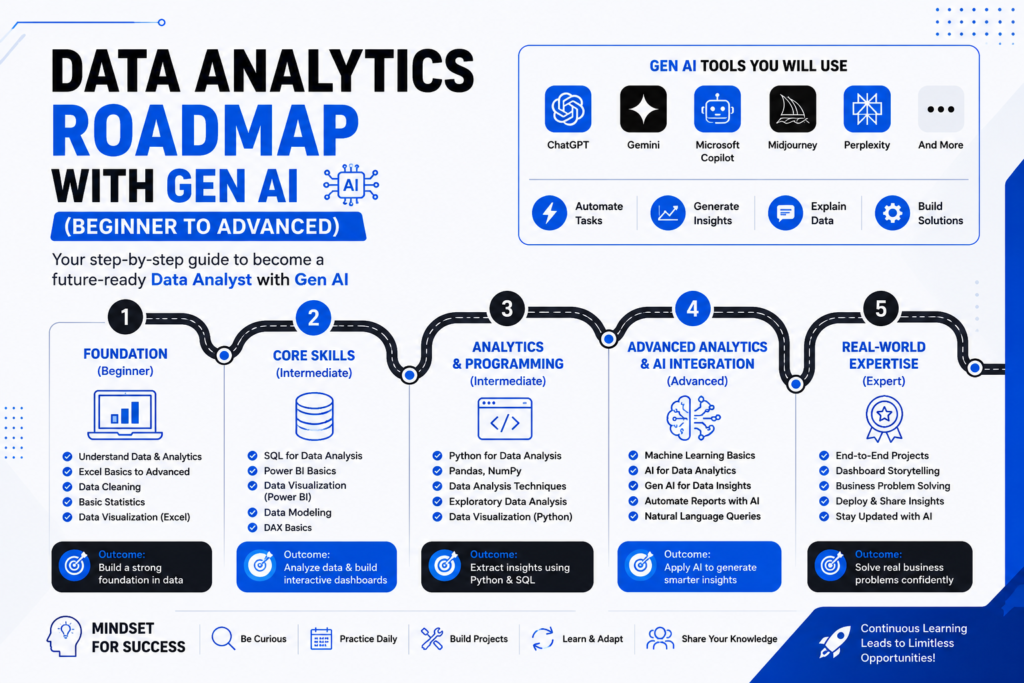
Data Analytics Roadmap with Gen AI, Beginner to Advanced
Data Analytics has become one of the most in-demand career paths globally. Companies across industries rely on data professionals to make informed decisions, optimize operations, improve customer experience, and drive growth. With the rise of Generative AI (Gen AI), the field is evolving even faster. Today, learning only traditional analytics tools is not enough—professionals must combine analytics knowledge with AI-powered tools to stay competitive.
If you want to build a successful career in Data Analytics, this roadmap will guide you from beginner to advanced level.
Stage 1: Foundation (Beginner Level)
The first step is understanding the basics of data and analytics. Beginners should start with core concepts such as:
- What is data analytics?
- Types of analytics: descriptive, diagnostic, predictive, and prescriptive
- Business use cases of data
You should also learn Microsoft Excel, as it remains one of the most widely used tools for data analysis.
Important Excel topics:
- Formulas and functions
- Pivot tables
- Charts and graphs
- Data cleaning basics
- Conditional formatting
Statistics fundamentals are equally important:
- Mean, median, mode
- Probability basics
- Standard deviation
- Correlation and regression
This stage builds your analytical mindset.
Stage 2: Core Skills (Intermediate Beginner)
Once fundamentals are clear, move to structured data handling tools.
Learn SQL
SQL is essential for working with databases. Almost every organization stores data in SQL databases.
Important SQL concepts:
- SELECT statements
- WHERE conditions
- GROUP BY
- JOINs
- Subqueries
- Aggregate functions
SQL helps analysts extract and manipulate business data efficiently.
Learn Power BI
Power BI is a powerful business intelligence tool used for dashboards and reporting.
Key Power BI skills:
- Data import and transformation
- Power Query
- Data modeling
- DAX formulas
- Dashboard creation
- Interactive reports
Power BI is highly in demand across industries.
Stage 3: Programming & Advanced Analysis
At this stage, start learning Python for advanced analytics.
Python libraries to focus on:
- Pandas
- NumPy
- Matplotlib
- Seaborn
- Scikit-learn
Python helps with:
- Data cleaning automation
- Exploratory Data Analysis (EDA)
- Visualization
- Predictive analytics
You should also practice working on datasets and solving real business problems.
Stage 4: Gen AI Integration
This is where modern analytics becomes future-ready.
Learn how Gen AI tools can improve productivity:
- ChatGPT for SQL generation
- AI for Python code assistance
- Automated report summaries
- Data storytelling
- Dashboard insights explanation
AI can help analysts automate repetitive tasks and improve decision-making speed.
Skills to learn:
- Prompt engineering
- AI workflow automation
- AI-assisted analysis
- Natural language analytics
This combination makes you highly valuable.
Stage 5: Advanced Level & Real Projects
At the advanced stage, focus on portfolio building and practical implementation.
Work on projects such as:
- Sales dashboard
- Customer churn analysis
- Financial forecasting
- Marketing campaign analysis
- HR analytics dashboard
Deploy projects on GitHub or portfolio websites.
Also focus on:
- Machine learning basics
- Business problem-solving
- Stakeholder communication
- Data storytelling
These skills separate beginners from professionals.
Career Opportunities
After completing this roadmap, you can target roles such as:
- Data Analyst
- Business Analyst
- Power BI Developer
- AI Analyst
- Data Consultant
- Analytics Specialist
Final Thoughts
Data Analytics with Gen AI is the future of business intelligence. Traditional analytics skills like Excel, SQL, Power BI, and Python remain essential, but combining them with AI tools creates a strong competitive advantage.
Start with the basics, build strong fundamentals, practice consistently, and gradually integrate AI into your workflow. The future belongs to professionals who can analyze data and leverage AI for smarter insights.
Your journey from beginner to advanced data analyst starts today.