How Gen AI is Changing Data Analytics Jobs
The rise of Generative AI (Gen AI) is reshaping industries worldwide, and one of the most impacted fields is Data Analytics. Traditionally, data analytics focused on collecting, cleaning, organizing, and interpreting data to help businesses make informed decisions. Data analysts spent hours building dashboards, writing SQL queries, preparing reports, and identifying trends. However, with the introduction of Gen AI, the way data professionals work is evolving rapidly.
Generative AI refers to artificial intelligence systems capable of generating content, insights, recommendations, and even code based on user input and available data. Tools powered by AI can now automate repetitive tasks that previously consumed a large portion of a data analyst’s time.
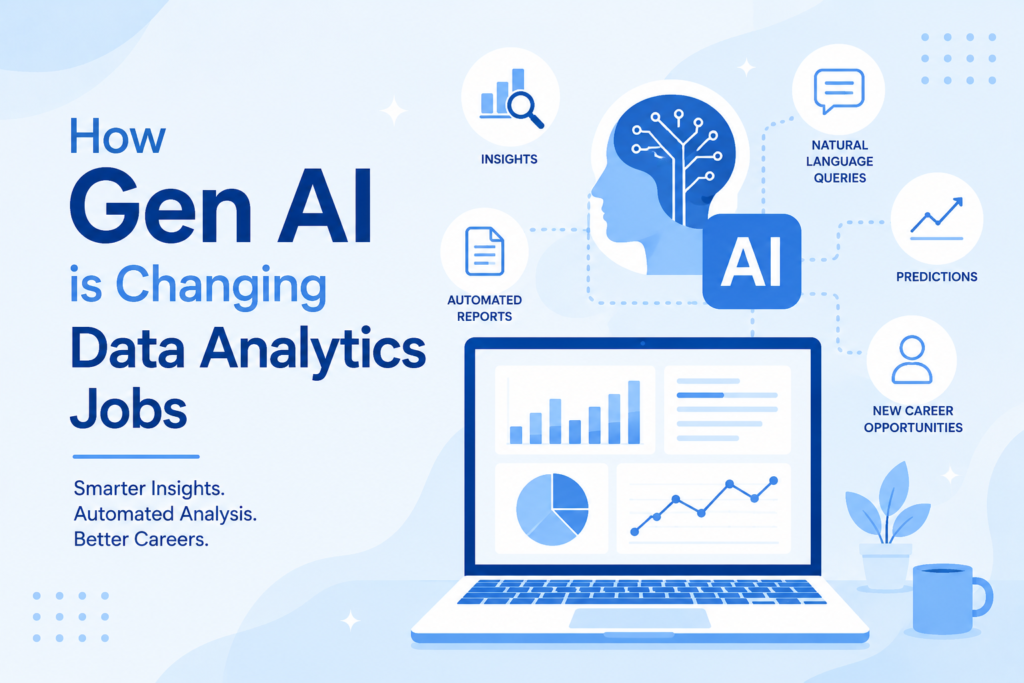
One of the biggest changes Gen AI brings is automation. Tasks such as data cleaning, report generation, dashboard summaries, and documentation can now be completed in minutes. Instead of manually preparing weekly reports, analysts can use AI to instantly summarize data performance and generate insights. This allows professionals to spend less time on repetitive tasks and more time on strategic problem-solving.
Another major impact is the simplification of technical work. In the past, analysts needed strong coding knowledge in SQL, Python, or R to query and manipulate data. Today, Gen AI tools allow users to generate SQL queries, Python scripts, and formulas simply by using natural language prompts. This lowers the barrier to entry for beginners while increasing productivity for experienced professionals.
For example, a user can ask an AI tool, “Show me last quarter’s sales growth by region and highlight underperforming markets,” and receive a ready-made analysis within seconds. This improves speed, accuracy, and accessibility.
Gen AI is also improving predictive analytics. Traditional analytics mainly focused on historical data, but AI-powered systems can forecast trends, customer behavior, market demand, and business risks more efficiently. Companies can now predict customer churn, identify fraud patterns, optimize inventory, and improve marketing strategies using AI-driven analytics.
As a result, job roles in data analytics are changing rather than disappearing. While some repetitive responsibilities are being automated, the demand for skilled professionals is actually growing. Organizations now need analysts who can combine domain expertise, business understanding, and AI tool knowledge.
New career opportunities are emerging, including AI Analyst, Prompt Engineer, Data Product Manager, AI Business Consultant, and Analytics Automation Specialist. Traditional roles such as Data Analyst, Business Analyst, and BI Developer are also evolving to include AI integration skills.
To stay relevant, aspiring data professionals should focus on building both foundational and future-ready skills. Core skills such as Excel, SQL, Python, Power BI, Tableau, and statistics remain important. At the same time, learning Gen AI tools, prompt engineering, machine learning basics, and automation workflows is becoming essential.
Another important shift is decision-making speed. Businesses operate in highly competitive environments where fast decisions can create major advantages. Gen AI helps organizations move from reactive analytics to proactive intelligence. Instead of only understanding what happened in the past, teams can quickly identify what is likely to happen next and what action should be taken.
Despite its advantages, Gen AI is not replacing human intelligence. AI can automate analysis and generate suggestions, but human professionals are still needed to validate results, understand business context, ask the right questions, and make strategic decisions. Critical thinking, communication, and problem-solving remain irreplaceable skills.
For students and working professionals, this transformation presents a major opportunity. Learning Data Analytics with Gen AI can significantly improve career prospects, increase earning potential, and open doors to global job opportunities. Companies across finance, healthcare, retail, education, and technology are actively investing in AI-powered analytics teams.
In conclusion, Gen AI is changing data analytics jobs by making workflows faster, smarter, and more efficient. It is automating repetitive tasks, enhancing predictive capabilities, and creating entirely new career roles. Rather than fearing automation, professionals should embrace AI as a productivity partner. The future belongs to those who can combine analytical thinking with AI-driven tools. As businesses continue their digital transformation journey, Data Analytics with Gen AI will remain one of the most valuable and future-proof career paths in the modern job market.